
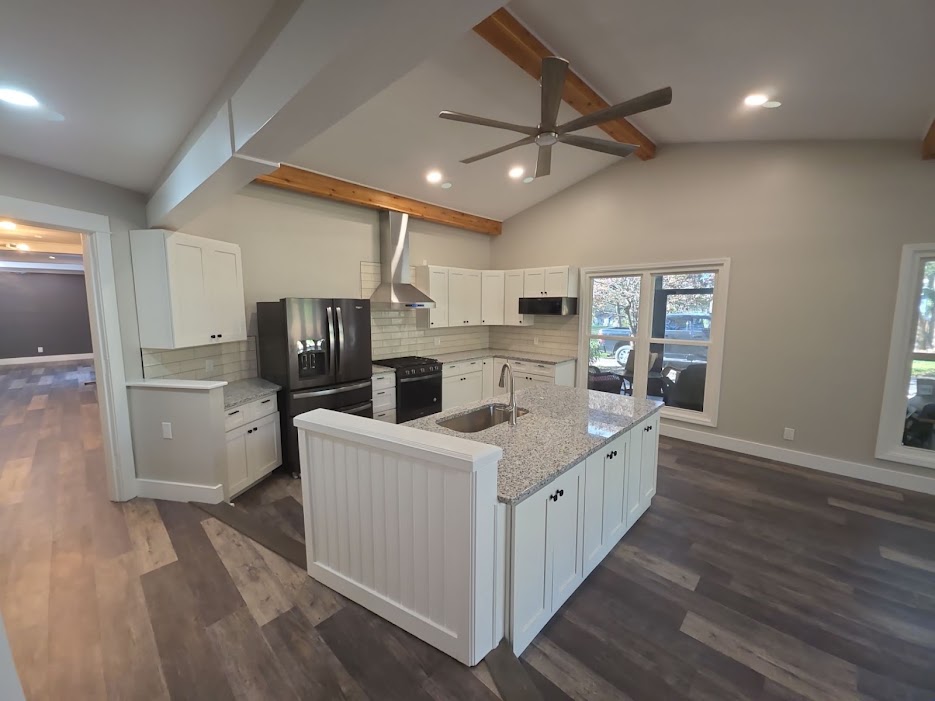
Cabinet Refacing vs. Replacement for a Knoxville Kitchen
Plenty of Knoxville kitchens have cabinets that have outlasted several owners. In established neighborhoods like Fountain City, Bearden and Sequoyah Hills, it is common to open a dated door and find a solid, square box behind it. That is the situation where cabinet refacing in Knoxville deserves a real look, because the part you are tired of seeing is often not the part that is worn out.
Refacing keeps your existing cabinet boxes and replaces what you see: the doors, the drawer fronts and the hardware, with a new veneer applied over the exposed frames and end panels. Replacement removes the cabinets entirely and installs new ones. Refacing usually fits when the boxes are sound and the layout works for you. Replacement is the better call when the boxes are damaged, the layout needs to change, or the cabinets are coming out anyway as part of a larger kitchen remodel.
What refacing includes, and what it leaves alone
A refacing job typically covers three things:
New doors and drawer fronts, in a new style, color or material.
A new surface on the face frames and exposed sides, usually a wood veneer or laminate applied over the existing frame so it matches the new doors.
New hardware: hinges, slides where needed, pulls and knobs.
What stays is just as important. The cabinet boxes, the shelves inside them, the overall layout and, in most cases, the countertops all remain in place. Your sink, dishwasher and range stay where they are.
There is also a third, lighter option worth knowing about. Refinishing keeps the existing doors and boxes and simply paints or restains them. It changes the color but not the door style, and it depends entirely on the doors being in good shape. Refacing sits between refinishing and full replacement: a new look on the outside, the original structure on the inside.
1. The condition of the cabinet boxes
This is the deciding factor, and it is the one most people skip. New doors cannot fix a box that is failing.
Start with the sink base. It is the cabinet most likely to have taken water over the years, from a slow drain leak, a dishwasher supply line or a wet sponge left on the edge. Press on the cabinet floor. If it feels soft, looks swollen or shows dark staining, that box has a problem. Particleboard and MDF that have swollen from moisture do not shrink back, and East Tennessee's long, humid summers do older cabinets no favors when there is any leak underneath.
Then check the rest of the run. Do the doors close evenly? Are the face frames tight to the boxes? Do shelves sag in the middle? Solid wood or plywood boxes that are dry and square are good candidates for refacing. Boxes that are pulling apart, sagging or water damaged are not.
2. Whether the layout works for how you cook
Refacing keeps your current footprint exactly as it is. That is fine if the layout already works and you mostly dislike how the kitchen looks.
It is a problem if you want to add an island, move the sink, close up an awkward corner, open a wall or fit a larger refrigerator or a wall oven. Each of those changes the boxes themselves, which puts you in replacement territory. A useful question to ask yourself: if the doors were already the style you wanted, would you still be frustrated with this kitchen? If the answer is yes, the frustration is probably about layout, and refacing will not solve it.
3. What happens to your countertops
Because refacing leaves the boxes in place, the countertops usually stay put too. If you installed granite or quartz in the last few years and still like it, that is a strong point in refacing's favor.
Replacement is different. Countertops are fitted to the cabinets underneath them, so removing the cabinets generally means removing the tops as well, and stone tops do not always come off cleanly enough to reuse. If your countertops are dated and you planned to replace them anyway, this factor stops mattering and replacement becomes easier to justify.
4. How long you plan to stay
If you expect to sell in the next few years, refacing can give a dated kitchen a cleaner, more current look without rebuilding it. If this is the home you plan to stay in, it is worth thinking about the kitchen you will want to use day to day, not just the one you want to look at. Long-term owners are more likely to want deeper drawers, better corner storage or a different layout, and those point toward replacement.
If the cabinets are one part of a bigger plan for the house, our guide to whole house remodeling and where to start can help you decide what to tackle first.
5. How much disruption your household can handle
Refacing is a lighter job. The boxes, countertops, plumbing and appliances stay where they are, so there is no tear-out and the kitchen usually remains partly usable while the work is done.
Replacement is a full renovation. The old cabinets and countertops come out, plumbing and appliances get disconnected and reconnected, and the kitchen is out of service until the new tops are installed. For a sense of how a larger project unfolds from planning to finish, see our remodeling timeline.
Refacing or replacement: a side-by-side look
Factor | Points toward refacing | Points toward replacement |
|---|---|---|
Cabinet boxes | Solid wood or plywood, dry and square | Swollen, soft, water stained or sagging |
Layout | Works for how you cook | Needs an island, a moved sink or new appliance sizes |
Countertops | Fairly new, in good shape and staying | Due for replacement anyway |
Storage inside | Shelves and drawers mostly fit your needs | Want deep drawers, new heights or specialty storage throughout |
Time in the home | Refreshing before a sale, or happy with the current setup | Long-term home you want to redesign |
Disruption | Want the kitchen usable during the work | Already planning a larger remodel |
Where refacing goes wrong
When homeowners describe regret about refacing, the complaint is rarely about the new doors. It is usually one of two things: they paid to put new faces on boxes that were the real problem, or they refaced and then realized the layout still did not work for them.
Both come from deciding on looks before checking structure. New veneer applied over a damaged or greasy frame can lift or peel, and a beautiful new door on a sagging box still hangs crooked. A good refacing job starts with someone pulling everything out of the sink base, checking the corners and toe kicks, and telling you honestly whether the boxes are worth keeping. If no one looks inside the cabinets before quoting the job, treat that as a warning sign.
Signs your cabinets are good candidates for refacing
Doors open and close evenly, and the boxes feel solid when you push on them.
The sink base floor is firm, dry and free of staining.
You like the layout and the amount of storage.
Your countertops are recent and staying.
Your complaints are mostly about style: the door profile, the finish or the hardware.
Signs replacement is the better call
The sink base floor is soft, swollen or water stained.
Face frames are cracked, or boxes are separating from each other or from the wall.
You want to change the layout, add an island or move appliances.
You are replacing the countertops and flooring anyway.
You want storage the current boxes cannot provide, such as deep drawer stacks in place of base shelves.
What to ask before you book
Will you inspect the cabinet boxes, including the sink base, before giving me a price?
What material are the new doors and drawer fronts, and what is applied to the face frames?
Does the quote include hardware, end panels, filler strips and any trim or molding?
What happens if you find water damage or a failing box once work starts?
Will my countertops stay in place, and what happens if one is disturbed?
Can I see photos of kitchens you have completed?
Can you itemize the quote so I can compare it fairly with others?
That last question matters more than most homeowners expect. Our guide on how to get accurate remodeling quotes explains how to make sure two bids are actually describing the same job.
Common questions
What is the downside of cabinet refacing?
Refacing keeps your existing boxes, layout and interior storage. It does not fix water damage, sagging shelves or a layout that does not work, and the finished kitchen is only as sound as the boxes underneath the new surfaces.
What is the average cost to reface a 10x10 kitchen?
A "10x10 kitchen" is a common industry shorthand for a small L-shaped kitchen with two 10-foot walls of cabinets, used to compare cabinet pricing. The cost of refacing one depends on the door material and style, the veneer, the number of doors and drawer fronts, any added pieces such as new pull-outs or molding, and the condition of the boxes. The most reliable way to compare is to get itemized quotes for the same scope of work.
Is refacing cheaper than replacing cabinets?
Refacing is generally the less expensive option because the boxes stay and the countertops usually stay too. The gap narrows when a refacing job adds many upgrades or when boxes need repair before the new surfaces go on.
How long does cabinet refacing last?
The new doors, drawer fronts and veneer are new surfaces and wear like any new cabinet finish. The boxes underneath keep their original age, so how long a refaced kitchen holds up depends largely on the condition of the boxes when the work is done.
Planning a kitchen update in Knoxville
Whether you lean toward refacing or a full replacement, the right answer for your Knoxville kitchen starts with what is behind the doors, not just what is on them. MEL Realty Repairs handles kitchen remodeling for homeowners in Knoxville, TN. Visit our kitchen remodeling services page to see how we approach kitchen projects, or contact us to talk through yours.